














Branding
B2B Branding Strategy: Positioning, Proof and Buying-Committee Trust
Sep 6, 2026
/ By Hamoun Ani
Brand strategy consulting that ends in decisions, a position to hold and an effective message to repeat.
Brand strategy is Brand Vision's foundational discipline, the work every other service we offer is built on. It matters because customers who cannot tell companies apart choose on price, and strategy is what makes the difference visible. As a brand strategy agency, we research the market, define the position, and write the messaging, delivered as documents your team can actually run on.

Building real partnerships with top global brands. Delivering results that last well beyond the launch.











The full strategic foundation, from positioning and messaging to architecture and go-to-market.

Brand positioning defines where your business sits in the market, which customers it serves best, which competitors it is compared against, and why it should win that comparison. Brand Vision develops brand positioning services through research into your category and buyers, then delivers a written positioning statement your team can apply to pricing, product, and marketing decisions. We make the position specific, because a position that could describe any competitor guides nothing.

A brand messaging framework organizes what your company says. It defines the value proposition, the three or four key messages that support it, and the proof points behind each, so websites, sales decks, and campaigns all draw from the same source. Brand Vision builds the framework from customer research and real sales conversations, then writes it in language ready to use directly. The test is simple, a new employee should be able to describe the business correctly using it.

Brand architecture defines how your company, products, and services relate, whether everything sits under one name, separate names serve separate markets, or a mix of both. Brand Vision reviews what each brand contributes, what each costs to maintain, and where customers get confused, then recommends a structure with clear naming levels and rules for future additions. As a brand strategy agency, we treat architecture as a budget decision as much as a design one, since every separate brand needs separate marketing.
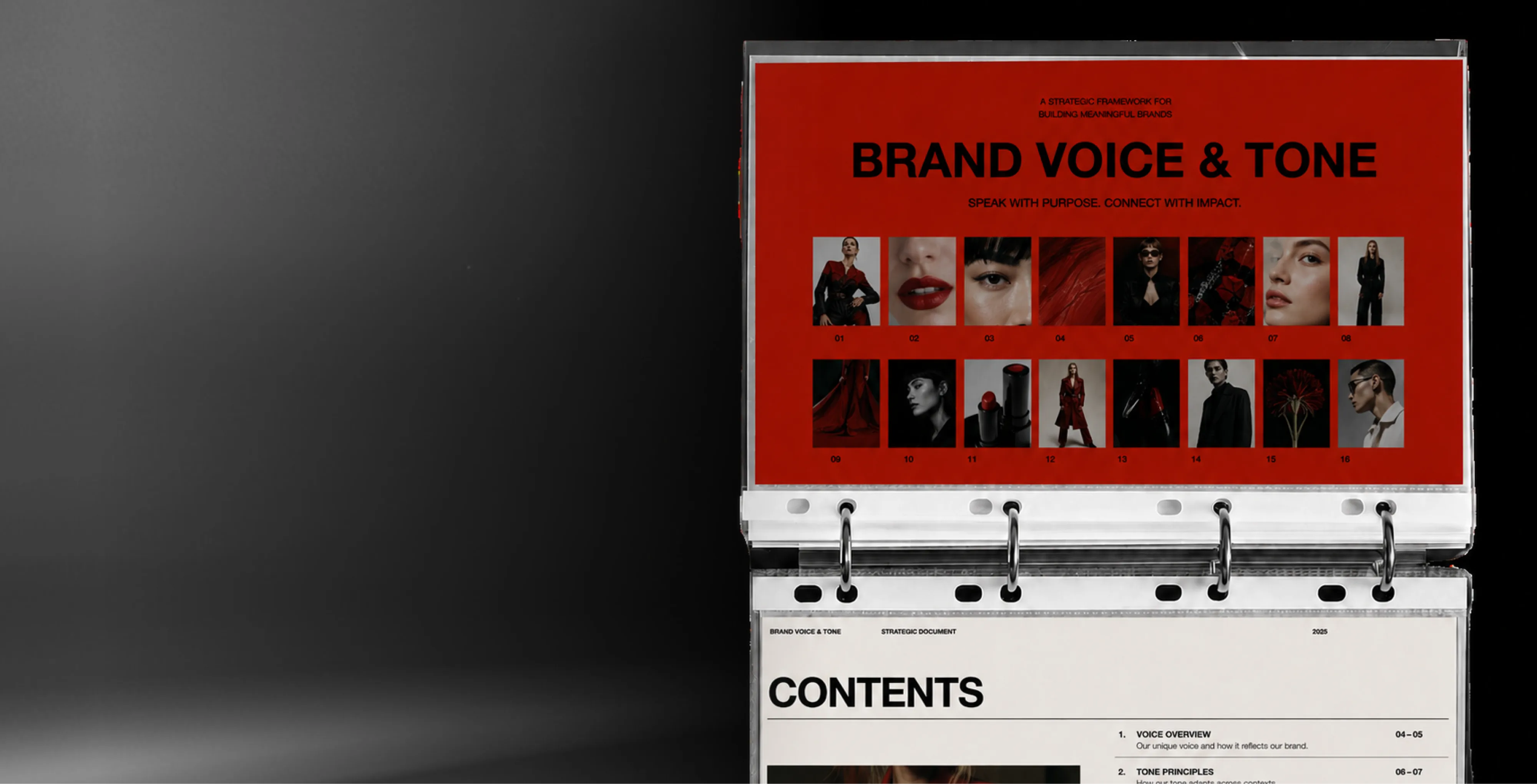
Brand voice development defines how your company sounds in writing, the personality traits that stay constant and the tone adjustments for different situations, a sales page, a support reply, an apology. Brand Vision documents the voice with side-by-side rewrites showing correct and incorrect versions, because examples are easier to follow than adjectives. The guide is written for daily use by your team and the AI writing tools they work with, so everything the company publishes sounds consistent.

Purpose, mission, vision, and values only matter if they influence decisions. Brand Vision works with leadership to define each one, tests drafts against real choices the business has faced, would this statement have changed the call, and cuts anything that would not. The result is a short set of statements your company can hire against, build against, and decline work against. If a statement changes nothing, we recommend leaving it out.

A strategy needs a launch plan to produce results. Brand Vision builds it, the priority order of audiences, the channels for each, the offers and proof each stage needs, and the campaign sequence that carries the new position into the market. We plan relaunches the same way as launches, since a repositioned brand has to re-earn attention just like a new one. The deliverable is a schedule your team or ours can run.
From research to a position your whole team can run on.
We study your market, competitors, and buyers to find the ground your business can credibly own.
We define a specific position: the customers you serve best and why you win the comparison.
We write the messaging framework, the value proposition, key messages, and the proof behind each.
We turn the strategy into a go-to-market plan your team or ours can run.
Selected positioning and messaging engagements from our work as a brand strategy agency.
What makes a company distinct depends on what its category competes on. Brand Vision maps those dynamics first, then positions each business on the axis its buyers decide by, which differs more between industries than most strategies admit.












Product depth shouldn’t slow the story down. We partner with SaaS, platform, and enterprise software teams to translate technical capability into focused narratives. Clear paths to demo, trial, or contact serve both buyers and technical evaluators. Systems are built for product-led growth with composable components, editor guardrails, and instrumented analytics that tie directly to pipeline.
Complex services sell on clarity, not volume. We help consulting, financial, and advisory firms structure their digital presence around buyer tasks: understanding capabilities, comparing options, and starting a brief. Every touchpoint earns trust through specificity and proof. Content is organized by audience need, so the people making the hiring decision find answers quickly and move to contact without friction.
Patients and practitioners make high-stakes decisions under pressure. We design trust-first experiences for healthcare and wellness brands, keeping clinical accuracy intact while making it simple for people to find the right provider, service, or next step. Accessibility, privacy-compliant forms, and plain-language content are standard. Local visibility for practices and clinics is built into the foundation, not bolted on later.
Prospective clients searching for legal help are often under pressure and comparing firms quickly. We help law firms present practice areas with credibility, surface the right contact paths, and build a digital presence that earns trust before the first conversation. Clear structure, plain language, attorney profiles, and consultation flows make it easy for people to take the next step with confidence. Ethical advertising compliance is built in from the start.
Buyers, investors, and project owners move on trust and timing. We work with brokerages, developers, general contractors, and property management firms to present listings, projects, and capabilities with clarity. Content is organized around what prospects actually need: proof of work, service scope, location context, and a direct path to inquire. Pre-construction launches and trade portfolios get the same strategic rigor as resale platforms.
Conversion lives in the details. We work with consumer and ecommerce brands to build fast, clear shopping experiences where product pages explain value quickly, checkout flows reduce friction, and the entire system scales with the catalog. Promotional templates, collection architecture, and performance monitoring keep the storefront sharp as demand and inventory shift with seasons. The result is a store your team can run day to day without developer dependency.
Early-stage companies need focus over flash. We help startups define positioning, build a credible identity, and launch a conversion-ready presence that clearly communicates what the product does, who it’s for, and how to get started. Everything is built to scale: component systems, content structures, and analytics foundations grow with the roadmap instead of needing a rebuild at Series A. The pitch and the website tell the same story.
Students, parents, and administrators all need different answers from the same site. We help schools, universities, and training organizations structure digital experiences by task: apply, visit, inquire, enroll. Accessible design and plain-language content serve diverse audiences without alienating any of them. A manageable CMS means internal teams keep program pages, event listings, and admissions information current without outside help or bottlenecks.
Nonprofits compete for attention, funding, and volunteers simultaneously. We build accessible digital experiences that make programs clear, donation paths intuitive, and calls to action specific enough to drive real participation and support. Content governance is designed for lean teams, so pages, campaigns, and impact reports stay current without bottlenecks. The organizations doing the most important work deserve a digital presence that matches their mission.
From restaurants to packaged goods, this industry sells on quality and convenience. We help food and beverage brands connect story with logistics: clear menus, product lines, ordering options, and wholesale paths that make it obvious how to buy and reorder. Identity and digital experience work in tandem so visitors see quality and know exactly what to do next, whether they’re a consumer walking in or a distributor placing a first order.
Audiences decide in seconds. We work with labels, venues, talent agencies, and event companies to build media-rich, performance-optimized experiences where the work is front and center. Booking, inquiry, and ticket paths stay visible and fast across devices. Campaign templates and component systems let teams launch content for new shows, releases, and events without starting from scratch each time. The creative comes first; the infrastructure stays invisible.
Guests research and book across multiple touchpoints. We help hotels, resorts, tourism brands, and event venues present their experience with clarity, connecting visual storytelling with practical booking flows, local discovery, and seasonal content that stays current. The systems we build make it straightforward for teams to update rates, packages, and promotions without depending on a developer for every change. The experience starts online, and it should feel as considered as the stay itself.












Original research and expert perspective on design, branding, and the strategy behind both.
Still have questions? Contact us to discuss.
A brand strategy agency decides what a business stands for, who it is for, and why anybody should choose it over the alternative, then writes it down in a form a team can actually use. Everything downstream inherits those decisions, which is why getting them wrong is expensive in a way a bad logo never is.
Why it matters commercially, stated plainly. Customers who cannot tell companies apart choose on price. Strategy is the work of making the difference visible, and where it is absent every campaign has to buy attention from scratch and every sales conversation starts by explaining what you are.
Why clients choose us for it.
It is our foundational discipline. Positioning and messaging are what the rest of the practice is built on, so the strategy is not written by one team and handed to another. The people defining the position are in the room when it becomes an identity, a website, and a campaign.
The deliverable is decisions, not a deck. A written position, a messaging framework, and a voice guide in language ready to use. If a document cannot be applied to a pricing call, a job posting, or a landing page next week, it has not finished.
Research before opinion. More than 25 original brand studies published, and every engagement starts with the market and the buyers instead of a workshop about adjectives.
Positions get tested against the category, not against taste. Candidates are read next to the live claims of your closest rivals before anybody commits, because a proposition that sounds strong in isolation and repeats what four competitors already say will not win a single comparison.
We cut what changes nothing. A purpose statement, a value, or a key message that would not have altered a real decision the business faced gets removed. That is unusual and it is the reason the documents get used.
More than a decade of brand strategy consulting behind that, and you can see the work it produced and who does it before deciding anything.
Six components, and most engagements need four or five of them. Which ones depends on whether you are entering a market, repositioning inside one, or untangling a portfolio.
The commonest mistake is commissioning all six because they appeared on a list. A company entering a new market needs positioning, messaging, and a plan to enter with, and it does not need an architecture exercise for a portfolio of one. A company carrying eleven inherited product names needs architecture settled first and everything else after it.
Brand positioning. Where the business sits, which customers it serves best, which alternatives it is compared against, and why it wins that comparison. Delivered as a written positioning statement specific enough to apply to pricing and product decisions.
Brand messaging. The value proposition, the three or four key messages supporting it, and the proof behind each, written in language your team can use as-is instead of in strategic shorthand.
Brand architecture. How the company, its products, and its services relate. One name, separate names, or a mix, with naming levels and rules for future additions.
Brand voice and tone. How the company sounds in writing, with the constant personality traits and the tone shifts for different situations, documented with side-by-side rewrites.
Brand purpose. Purpose, mission, vision, and values, tested against real decisions and cut where they would not have changed one.
Go-to-market plan. The audience priority order, the channels, the offers and proof each stage needs, and the campaign sequence that carries the position into the market. Plans for a relaunch the same way as a launch, since a repositioned brand has to re-earn attention.
Underneath all of it sits market and customer research, which is where the position actually comes from, not a workshop. And downstream of it sit the things the strategy is an input to, meaning the identity system, naming where a new entity or service line needs one, and the marketing that carries it. Where the whole picture needs scoping at once, that is a full brand engagement.
Brand strategy is the decisions. Branding is the expression of those decisions. Marketing is the distribution of them. Three different jobs, done in that order, and conflating them is the most common reason a business spends money and feels no different afterward.
Put concretely.
Strategy answers questions. Who is this for. What do they currently do instead. What do we do better and for whom. What do we refuse to do. What do we want people to believe about us. What claim can we actually defend. Those answers are a document, and they are largely invisible to a customer.
Branding makes those answers visible. The name, the mark, the palette, the typography, the voice, the imagery. Every one of those is a choice that should be traceable back to a strategic decision, and when it is not you get work that looks good and means nothing.
Marketing puts it in front of people. Channels, campaigns, content, media. Marketing amplifies whatever is underneath it, which is why it makes a clear position more efficient and a confused one more expensive.
Two consequences worth naming.
Doing them out of order costs twice. A logo designed against an unsettled position gets redrawn when the position settles. A campaign built on a value proposition nobody agreed on gets rewritten. Businesses that come to us for a rebrand and discover they need positioning first are not being upsold, they are being told why the last two attempts did not stick.
Strategy is not a brand personality workshop. It is not a session producing five adjectives, a mood board, and a sense of alignment. Adjectives are not decisions. If the output does not tell you which customer to say no to and which competitor you are beating on what, it is a feeling and not a strategy.
Where the distinction matters most is budget. Strategy is the cheapest of the three and the one that determines the return on the other two, which is why we run it first and why the identity and marketing work that follows is scoped against it instead of beside it. The wider marketing practice is downstream of all of this by design.
You can skip it, and a good number of businesses do, and the cost shows up as a project that never quite lands rather than as an obvious failure. So here is the honest version of when to skip it and when not to.
When you can reasonably skip it. The position is already clear and everybody internally states it the same way. You are pre-product-market-fit and still testing what you are, in which case a comprehensive strategy locks in an answer you have not found yet. The project is small and tactical. Or you genuinely need something live in three weeks and a placeholder is honest.
When skipping it is the expensive choice. Three or more people describe the business differently. Your category is crowded and you sound like the rest of it. A multi-year budget is about to go out against a story nobody has settled. Sales conversations start with a long explanation of what you are. Or the last rebrand did not change anything, which is almost always a symptom of a design project sitting on an unresolved position.
Here is what actually happens without it. A logo project goes into revision loops that feel like taste and are really unresolved strategy, because nobody can say what the mark is supposed to signal. A website build stalls on the homepage headline for three weeks, since a headline is a positioning decision wearing copywriting clothes. And a campaign performs to the platform average, because the message is the same as everybody else's.
The cheapest version, and worth asking for directly. Not every business needs a full engagement. Sometimes it is a short positioning sprint producing one page that settles the argument, and that page then makes the design and marketing work faster and cheaper. Where that is the situation we will scope it that way instead of selling the larger thing.
What we will not do is design around an unresolved position and let you discover the problem in month four.
A focused positioning and messaging engagement runs four to six weeks. A full strategy including architecture, voice, purpose, and a go-to-market plan runs eight to twelve. Cost scales with how much primary research is involved and how many stakeholders have to agree.
The four stages, and where the time goes.
Research. One to three weeks and the heaviest part. Competitive audit, category dynamics, and interviews with customers, lost prospects, and your own sales team. This is the stage clients most want to compress and the one that determines whether the output is defensible or merely plausible.
Position. One to two weeks. The category frame, the audiences, the alternatives you are compared against, the points of parity and difference, and the reasons to believe. Presented and argued rather than delivered, because a position nobody challenged is a position nobody owns.
Message. One to three weeks. The value proposition, key messages, proof points, and the voice guide, written in usable language.
Activate. One to two weeks. The go-to-market plan, plus the internal rollout, which is covered further down and matters more than most people expect.
What moves the number. How much primary research is in scope, since recruited customer interviews cost real money and are worth it when the open question is about people, not mechanics. Number of audiences and segments. Whether architecture is involved, which is the most time-consuming component when a portfolio is tangled. How many decision-makers need to agree, which is the largest driver of the timeline and worth being honest about at kickoff. And whether the deliverable is a direction or a fully documented set of frameworks.
Two practical notes. Strategy is the cheapest thing in a branding budget and the thing that determines the return on the rest, so compressing it to protect the design budget is a false economy we will argue against. And where the honest recommendation is a shorter consultation before a full engagement, that is what gets proposed. Tell us the situation on the first call and you will get a straight read on which one you need.
Brand positioning is a decision about where you sit in a buyer's mind relative to the alternatives, written down clearly enough to argue with. Most positioning statements fail one test, which is that they could be about anybody.
Here is the test we apply. Swap your logo for your closest competitor's and read the statement again. If it still reads as true, it is not a position, it is a category description. A surprising number of published positioning statements fail that in about four seconds.
What a real position has to settle.
The category frame. What kind of thing you are, in words the market already uses. Getting this wrong is the most expensive error available, because a buyer who cannot place you cannot compare you and will not choose you.
The competitive alternative, honestly identified. Not the competitor you would like to be measured against, the thing your buyer would actually do instead. Very often that is a spreadsheet, an internal process, a consultant, or doing nothing. Positioning against a well-funded rival while most of your losses go to inertia means aiming your whole message at the wrong opponent.
The audience you are unreasonably good for. Narrower than most companies are comfortable with, and it should include who you are not for. Naming who should buy something else is the highest-trust move available in this work and almost nobody makes it.
Points of parity and points of difference. What you have to be adequate at to be considered at all, and what you are genuinely better at. Confusing the two produces messaging that brags about table stakes.
Reasons to believe. Proof the claim survives contact with a skeptic. A difference nobody believes is not a difference.
What you refuse to do, which is frequently the sharpest part of a position and the hardest for a leadership team to agree.
All of it comes out of market and buyer research, not a session about values, and the axis a business should position on differs enormously by category, which is why we map the dynamics in your industry before choosing one. The output is one written page, and if it takes longer than a page you have not decided yet.
A messaging framework organizes everything the company says so a website, a sales deck, and a campaign all draw from one source instead of inventing their own. Without one, three people write three versions and the market hears none of them clearly.
What it contains.
The value proposition. One statement of what you do, for whom, and what changes as a result. Short enough to be repeated correctly by somebody who does not work in marketing.
Three or four key messages. The pillars supporting the proposition. Not eight, because a business that says eight things says nothing. Each one is a claim you can defend.
Proof points under each message. Numbers, named customers, integrations, credentials, methodology, published work. Every claim needs something behind it, and the ones with nothing behind them get cut instead of softened.
Audience variants. The same argument emphasized differently for the different people involved in a decision. A technical evaluator and a finance lead need the same truth with different foregrounds, and inventing separate stories for each is how a company ends up contradicting itself.
Objection handling. The four or five things prospects actually say, with answers. This section gets used more than any other and it is usually missing entirely.
Elevator versions. One sentence, one paragraph, one page. Written out, so nobody has to improvise them under pressure.
Language rules. The words you own and the words you avoid, including the category jargon that makes you sound like everybody else.
The test we hold it to is the one on your page, and it is a good one. A new employee should be able to describe the business correctly using the framework alone. If they cannot, the document is too abstract.
Where it goes afterward matters as much as what is in it. The framework becomes the input to the content program, the website copy, and the sales material, and in complex sales it also has to arm the person selling you internally, which is covered in more depth in how we approach B2B.
Voice is the personality that stays constant and tone is what shifts by situation, and the guide only works if it shows rewrites instead of listing adjectives. Yes on the AI question, and it has changed what a voice guide has to be.
How we define it.
Position on a few real axes rather than pick adjectives. How formal, how warm, how direct, how much humour, how much technical detail as a default. Those are decisions with consequences. Friendly and professional are not, because every company claims both.
Personality traits tied to observable behaviour. If the brand is direct, that means leading with the answer instead of the context. If it is generous, it means giving the useful thing away before asking. A trait that does not change a sentence does not belong in the guide.
Tone shifts by situation, written out. A sales page, a support reply, an apology, a rejection, an outage notice, a job posting. Same voice, different tone, and the apology is the one that reveals whether a voice guide is real.
Side-by-side rewrites. The single most useful thing in the document. The same sentence written wrong and written right, with a note on what changed. Examples are followable in a way that adjectives are not, and they settle arguments faster than principles do.
What the brand would never say. Phrases, claims, and habits that are off-limits. This section does more work than the positive guidance.
On AI writing tools, which is now unavoidable. A voice guide has become an input to a machine as well as a reference for a person, and that changes how it should be written. It needs concrete rules a tool can follow, meaning sentence length preferences, banned words and constructions, whether contractions are used, how much hedging is acceptable, and example passages long enough to establish a pattern. Vague guidance produces generic output, and generic output at volume is how a brand voice quietly disappears. We write the guide to work in both hands, and where a team is generating a lot of content that consistency also affects how the brand reads to AI search systems deciding what to quote.
The practical measure is whether somebody outside the marketing team can produce something on-voice with the guide open. If not, it is a description and not a tool, which is also what makes it usable inside the content work that follows.
Brand architecture is the decision about how your company, products, and services relate, and it is a budget decision at least as much as a design one. Every separate brand needs its own marketing, its own recognition, and its own maintenance, and that cost is what most portfolio decisions ignore.
The models, and where each one earns its place.
One master brand covering everything. Products are descriptive names underneath a single company brand. Cheapest to run, every piece of marketing builds one asset, and the constraint is that everything has to fit under one story. Right for most businesses, most of the time.
Endorsed brands. Sub-brands with their own character, visibly backed by the parent. Useful when a product needs its own space and still benefits from the parent's credibility. Costs more than one brand and less than several.
Separate independent brands. Genuinely distinct names with no visible connection. Justified when audiences do not overlap, when a category would be damaged by association, when an acquisition carries equity worth keeping, or when price tiers need real separation. It is the most expensive structure available and the one companies choose too readily.
A hybrid, which is where most portfolios of any age actually sit, usually by accident rather than design.
How we work out which you need. What each existing brand actually contributes, what each costs to maintain across marketing and operations, where customers get confused, and whether the audiences genuinely differ or just feel like they should. Then a recommendation with defined naming levels and rules for what happens to the next product, because the absence of a rule is what produces sprawl.
The question underneath a request for a sub-brand is almost always the same. Is this a genuinely different offer to a genuinely different buyer, or is it an internal team wanting ownership of something. Both are understandable and only the first justifies the cost. We will ask it directly.
Where new names are needed, that runs through a naming project, including trademark screening before anybody grows attached. And where the architecture decision means retiring or absorbing a brand people recognize, the equity question has to be handled deliberately, which is a rebranding exercise with its own sequencing.
Only if they change decisions, and most of them do not. Which is why we test every draft against choices the business has already faced and cut the ones that would not have altered the outcome.
The test is one question. Would this statement have changed a real call you made in the last two years. A hiring decision, a piece of work you took or declined, a pricing choice, a product you cut. If the answer is no, the statement is decoration and it gets removed instead of reworded.
What makes them useful when they are.
Purpose has to be narrow enough to exclude something. A purpose that any company in your category could adopt is a slogan. The useful ones imply a trade-off, meaning there is something the business will not do even when it would be profitable.
Values have to be uncomfortable. Integrity, excellence, and teamwork are not values, they are the minimum for being in business, and nobody has ever listed dishonesty as an alternative. Real values sound like a choice. Speed over consensus. Depth over reach. Candour over comfort. Somebody reading them should be able to see what the business is giving up.
Vision needs a horizon and a picture. Where the business intends to be, specifically enough that you could tell whether you got there.
Mission is what you do about it today, and it should be plain, not lofty.
What they are actually for, in order of how often they get used. Hiring, because they tell a candidate whether they will fit and give you a reason to decline somebody talented. Declining work, which is the highest-value use and the one nobody expects. Settling internal arguments, since a values statement is most useful when two reasonable options conflict. And giving a team a reason to hold a standard when it would be easier not to.
A short set that people can recite beats a comprehensive set nobody remembers. Three or four values, in the team's own language, with an example of each in action.
And if the honest outcome of this work is two statements instead of six, that is a better result. It shows up in hiring immediately, which is why the careers page is usually the first place a real set of values becomes visible, and why the rest of what we do gets scoped against them instead of around them.
You cannot prove a position before you run it, so the honest answer is that we pressure-test it before launch and measure the things it should move afterward. Anybody claiming certainty in advance is selling confidence, not strategy.
Before launch, four tests. Can somebody outside the company repeat it correctly after hearing it once. Does it survive the swap test against a competitor's logo. Can every claim be substantiated. And does it make a decision easier, meaning it tells you which customer to decline and which feature to cut. A position failing any of those goes back before it ships.
Where possible, test it with the market. Message testing with real buyers, or running the new proposition in a small paid campaign against the old one before committing everything to it. That is not always affordable and it is worth doing when the stakes are high.
After launch, what to measure. Brand effects are slower and less directly attributable than campaign effects, and pretending otherwise is how brand budgets lose credibility.
What we will not do is claim causation from correlation. A quarter with better numbers had a lot of things in it. What we will do is name in advance which measures should move, over what period, and report honestly against them. Where the measurement setup itself is unreliable, fixing that comes first, and it is frequently the first finding in an audit engagement. The search-side indicators sit inside how we report on organic performance generally.
Most brand strategies fail internally rather than externally, which is why activation is part of the work instead of a hopeful final slide. A perfect position nobody in the building can repeat is worth less than a decent one everybody uses.
Where it dies, and every one of these is preventable. Leadership approves it and never mentions it again. Sales keeps using the old pitch because it is comfortable and nobody showed them the new one working. It lives in a document nobody can find. It never got translated into the specific things people produce, meaning email templates, proposals, job postings, and decks. Or it was written in strategic language that reads well in a boardroom and cannot be said out loud on a call.
What we do about it.
Internal launch before external. Your own people first. What changed, why, what it means for their job specifically, and what they should stop saying. A team that hears about a repositioning through a campaign will not carry it.
Language ready to use, not translated. The messaging framework and voice guide are written in the words people can say. If a document needs interpreting before it can be applied, it will not be applied.
Applied to real artefacts during the engagement. A homepage headline, a sales one-pager, a job posting, an outbound email. Showing the strategy working on three real things is what makes it credible, and it surfaces the places the framework does not quite hold while there is still time to fix them.
Sales in the room early. They will use whatever helps them in front of a client, so the framework has to be built partly from what they get asked. Involving them makes adoption a consequence instead of a campaign.
A go-to-market sequence. Audience priority, channels, offers, proof, and timing, so the position enters the market deliberately. A relaunch is planned like a launch because a repositioned brand has to re-earn attention, and where paid support carries the early weeks that gets scoped against the moment instead of left running flat. That is usually where paid media earns its place in this work.
One owner and a review rhythm. Somebody responsible for saying yes and no, and a check twice a year on whether what the company publishes still matches what it decided.
The measure we hold ourselves to is whether somebody who joined six months after the engagement can describe the business correctly. If they can, the strategy took. You can see what that looks like over time in selected work.

Our goal is to nurture your vision and provide innovative, custom solutions for all your marketing needs.


%2520(1).png)
.png)