



.webp)


Branding
B2B Branding Strategy: Positioning, Proof and Buying-Committee Trust
Sep 6, 2026
/ By Hamoun Ani
Brand strategy and digital marketing designed to turn destination interest into preference, bookings, and lasting guest relationships.
The guest begins forming an opinion long before arrival. The brand creates the expectation. The website, reviews, search presence, and booking journey determine whether that expectation feels credible. As a travel marketing agency, Brand Vision shapes those moments as one experience and creates a clearer path from early interest to direct action.

Building real partnerships with top global brands. Delivering results that last well beyond the launch.












Specialized travel marketing services designed to create desire, establish confidence, and remove friction from the path to action.
Travel & Hospitality
Web Design
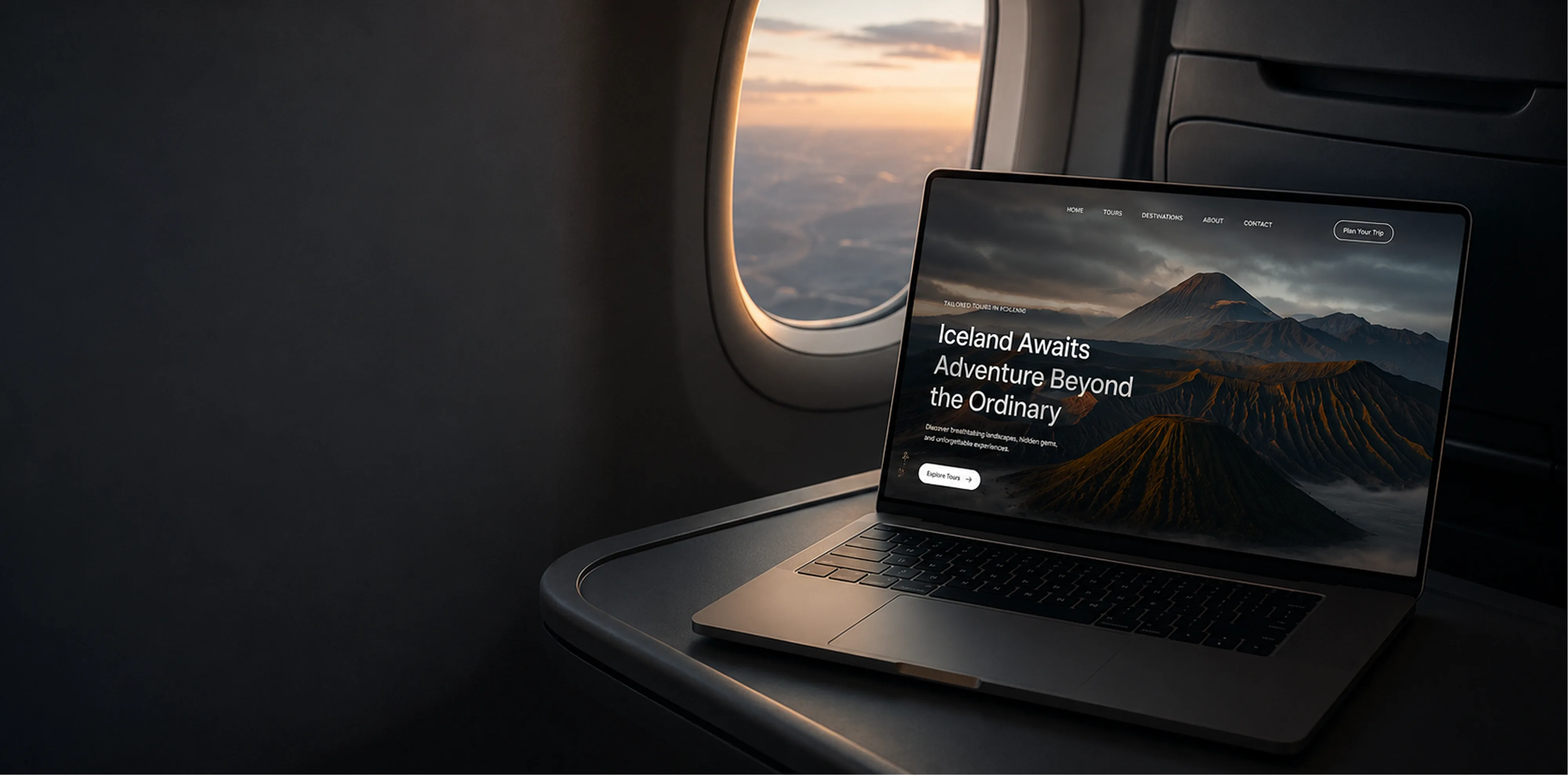
Booking platforms often present competing properties through the same structure. The direct website is where the difference can become visible again. Brand Vision gives the property space to express its atmosphere while making rooms, rates, policies, and high-value actions easy to find. The result supports both brand preference and direct conversion.

Travel & Hospitality
Branding
The strongest hospitality brands remain recognizable beyond a single property or season. Brand Vision studies the audience, competitive field, location, and experience before defining the identity. The system is built to hold together across physical and digital touchpoints while giving each property, offer, or destination enough room to remain distinctive.

Travel & Hospitality
SEO
Travel and hospitality brands compete with airlines, booking platforms, hotel groups, and destination publishers. Brand Vision finds where those larger competitors leave room, then builds an SEO and GEO strategy around opportunities the business can own. As a travel marketing agency, we focus on destinations, experiences, local searches, and direct-booking intent instead of traffic with little commercial value.

Travel & Hospitality
UI/UX Design
A guest may discover a hotel on their phone, compare it on a tablet, and book from a computer. Sometimes the entire decision happens within minutes. Brand Vision maps that journey and removes the friction between devices. As a hotel marketing agency with UI/UX expertise, we make rooms, packages, policies, availability, and booking actions clear on every screen.

Travel & Hospitality
Marketing Strategy
Travel demand moves with seasons, events, and booking windows, and the brands that win plan around them. Brand Vision builds a marketing strategy around the destination, the audience, and the moment a guest is ready to act, coordinating SEO, paid content, and email so the effort drives direct bookings instead of feeding the platforms. Every campaign is timed to when guests are actually deciding, not just when there's budget to spend.

Maintenance
& Support
Hotels and travel brands often need support long after the original project is complete. Brand Vision provides ongoing website management, creative support, and marketing consultation through one familiar team. We keep updates aligned with the brand, address technical issues, and act on new opportunities without needing to find a different partner for every request.

Built to win the
direct booking.
The booking platforms take a cut of every stay, and the guest relationship along with it. We build travel brands that get found locally, book direct, and keep guests coming back, so more of every stay stays with you.
Found where guests search.
Guests look nearby, in-destination, and by name. We make sure yours is the property they find first, backed by strong Google profiles and the reviews they trust.
Booked direct, not through a platform.
Every site and campaign is built to shift guests from the OTAs to your channels, so a bigger share of each stay lands with you.
One partner for all.
From brand and website to menus, signage, and campaigns, one team handles the whole thing, so nothing falls between vendors and the brand stays consistent everywhere.
Latest Work
in Travel & Hospitality
A selection of recent projects across web design, branding, and strategy.









Still have questions? Contact us to discuss.
A travel marketing agency that knows the sector understands that your biggest competitor is also your biggest distribution partner, and it builds everything around that tension. No other industry sells through channels that outrank it for its own name and take fifteen to twenty-five percent of the stay for the privilege.
That single fact reshapes the work. In most categories the job is winning attention against rivals. In hospitality the job is winning attention, then winning the transaction back from an intermediary the guest already trusts and finds easier to use. An agency that has not worked through that will optimize your traffic beautifully and watch the booking complete on Booking.com.
Four other things behave differently here.
Consideration is long and the decision is fast. A guest researches a destination for weeks and books in eleven minutes on a phone. That means the brand has to do slow work and the website has to do fast work, and they are judged on different criteria.
Third-party reputation is part of your product. Almost no other category has a public score attached to it at the moment of purchase. Review position on Google and TripAdvisor influences rate tolerance directly, which makes reputation an operational concern and not a marketing one.
Demand is not steady, it is shaped. Seasons, events, school calendars, and booking windows that differ by segment. A leisure guest books a beach property eight weeks out and a corporate guest books a downtown property on Tuesday for Wednesday.
The product is an experience nobody can test first. Which puts unreasonable weight on photography, description, and the credibility of everything around them.
So Brand Vision covers positioning and hotel branding, the site and booking path, search, and campaign timing as one system. Treating them as separate purchases is how properties end up with a beautiful brand, a site that loses people at the rate calendar, and a paid budget subsidizing their own OTA listings.
The order matters as much as the list. On most properties the booking path gets fixed before the brand work, because a property that converts better funds everything after it, and a repositioning that lands on a leaky booking flow only moves more people into the same leak. Where the sequence should run the other way, usually because the property is genuinely unsellable as currently described, we will say so.
By making the direct channel the obviously better option at the exact moment a guest is comparing, and by defending the searches where they are already looking for you by name. Nobody has ever won this with a "Book Direct" badge in the header.
The mechanics that actually move direct share.
Defend your brand terms. When somebody searches your property by name, the OTAs are frequently bidding on it and sitting above your own listing. Paid coverage on your own brand looks like a waste until you calculate the commission on every booking that leaks through it. It is usually the highest-return paid spend a property has available.
Compete on value, not on published rate. Most distribution contracts include parity clauses that limit undercutting the public price. What they generally do not restrict is what the direct channel can add. Room upgrades subject to availability, free breakfast, parking, late checkout, resort credit, flexible cancellation, or a member rate behind a login. Guests will trade a platform's convenience for a tangible benefit, and a specific one beats "best rate guaranteed" every time.
Remove the friction gap. OTAs win on ease. If your booking path takes more steps, loads slower, or hides the total until step four, you have handed them the transaction. Rate and availability visible immediately, total cost including fees shown early, and a mobile flow that works on one thumb.
Show up in metasearch and Google's booking surfaces. Free booking links and Hotel Ads put your direct rate beside the platforms at the comparison moment, which is where parity works in your favour instead of against you.
Recover the abandons. Look-to-book ratios in this category are brutal. Abandoned booking email, retargeting on the specific room type viewed, and a pre-arrival sequence that upsells instead of merely confirming.
Own the guest afterward. Direct bookings give you the email address. That is the actual asset, because a repeat guest costs almost nothing to acquire.
The honest position on OTAs is that they still have a role. Billboard exposure in new markets, filling genuine need periods, and reaching audiences you cannot reach yourself. The goal is not zero, it is a healthier mix, and a travel marketing strategy that names the target share instead of implying the platforms are the enemy.
Not on the head terms, and that is a strategy and not a concession. A single property will not outrank Booking.com for "hotels in Toronto," and chasing it is the most common way hospitality SEO budgets get wasted.
Where the large players are genuinely weak is specificity. Their pages are templated across thousands of properties, which means they cannot write with real knowledge about anything. That leaves four categories of opportunity.
Proximity and neighbourhood intent. Searches attached to a landmark, venue, hospital, campus, convention centre, or district. These convert far better than city-level terms because the guest has already decided where they need to be, and the platform result cannot explain the walk.
Specific room and stay types. Suites with a kitchen, connecting rooms, accessible rooms, pet-friendly, extended stay, adjoining for families. Real inventory detail that an aggregator flattens into a filter.
Purpose-driven pages. Weddings, corporate groups, meetings and events, and where relevant the restaurant or bar as its own entity with its own search demand. Group and event business is high value, rarely booked through an OTA, and chronically under-served on hotel websites.
In-destination content with actual expertise. Not another generic list of things to do. What the front desk tells guests. Where to eat on a Tuesday when everything is closed, how long the drive really takes, which season the thing they came for is actually good. This is where content built on real knowledge beats scale, and it is what earns the links and citations that lift everything else.
Underneath all of it, the technical foundations of hotel SEO have to hold. Correct hotel and lodging structured data so amenities, rates, and ratings can be read by machines, clean indexation across room and rate pages, and mobile performance that survives a hotel photography library. That work sits in technical SEO, and skipping it means the content never gets a fair hearing. Brand Vision approaches travel SEO the same way at every scale, and the full picture is in our search practice.
Guests search three ways, nearby, in-destination, and by name, and the map results are where the first two get decided. This is the part of hotel marketing services that operators most consistently underinvest in. For a property with a physical address, this is frequently the highest-intent traffic available and the most commonly neglected.
What actually moves position.
For multi-property groups this becomes a discipline instead of a task, because each location needs its own profile, its own reviews, and its own local content, managed without the properties competing with each other. That is the substance of local search work and it compounds quietly. On the operational side, the single highest-return habit is a review request built into the checkout or post-stay email, sent to the guests who had a good stay. Most properties leave that entirely to chance while paying for ads to make up the difference.
On the direct channel it sets the ceiling, and hospitality has a specific pattern of leaks that shows up on nearly every property we audit. Look-to-book ratios in travel are low enough that small friction carries outsized cost, and as a hotel marketing agency we tend to find the same problems in the same order.
In rough order of how often it turns out to be the problem.
Rate and availability are hidden. A guest who cannot see whether their dates are open, at what price, within a few seconds, opens a platform tab. Surfacing live rates on the room page rather than behind a search step is the highest-impact change available on most hotel sites.
Total cost arrives late. Resort fees, cleaning fees, and taxes revealed at step four produce abandonment and resentment. Showing the honest total early converts worse on that click and better on the booking.
Photography is doing the wrong job. Twenty atmospheric shots and no clear picture of the actual room, the actual bathroom, or the actual view. Guests want to know what they are buying before they want to feel something about it.
Policies are unclear. Cancellation terms, deposits, check-in windows, and pet rules. Ambiguity at the decision moment reads as risk, and risk sends people to a platform whose cancellation terms they already trust.
Mobile is the real experience and gets treated as the smaller one. Date pickers that fight a thumb, forms that need two hands, and image libraries that stall on hotel wifi.
Speed on the whole path. A homepage scoring well while the booking flow takes eight seconds is a scoring exercise, not a fast site.
The fix is a mix of hotel UI/UX design, meaning interface work, and honest merchandising, and it is worth measuring properly first. A UX audit on the two journeys that carry revenue, meaning the room booking path and the enquiry path for groups and events, tells you where the money is going in about two weeks.
Yes on both counts, and the change is more significant here than in most categories, because trip planning is exactly the kind of messy multi-condition question these tools are good at. A guest no longer searches "Nashville hotels." They ask for a walkable boutique property near the venue, with a dog, for two nights, under a number.
What comes back is assembled from sources, and if your property is not in those sources it does not exist in the answer. So the work is about being findable and quotable by machines.
Structured facts a system can extract without guessing. Amenities, room types, capacity, policies, distances to named landmarks, and rates in a format that is machine-readable instead of buried inside a graphic or a PDF.
Entity clarity. The property, the restaurant, the venue, and the group they belong to, each described consistently everywhere they appear. Ambiguity about what your property even is gets resolved by the model choosing something else.
Review consensus. These systems lean heavily on what independent sources agree about you. A property described consistently across platforms as quiet, walkable, and good for families will surface for those queries. One with contradictory signals will not surface at all.
Presence in the sources that get cited. Local publications, destination guides, and specialist lists. Which makes editorial coverage and digital authority a direct booking input instead of a vanity exercise.
Content written to be lifted. A clear question answered directly underneath it, in plain sentences. A page that opens with three hundred words of destination poetry before saying how far the airport is will lose to one that answers first.
One technical detail worth knowing, because it disqualifies a lot of otherwise decent hotel sites. Several major AI crawlers request JavaScript files without executing them, so anything that only appears after a script runs is invisible to them. Availability widgets, tabbed amenity lists, and accordion policy sections are common casualties. We check that early in any AI search engagement.
Work alongside it, and the integration quality matters more than almost any other decision in a hospitality web design project. Most properties are not replacing a booking engine, they are wrapping a better experience around one they are contractually stuck with.
What we look at first is how the handoff behaves. Three patterns exist and they are not equal.
Full redirect to a third-party domain. The guest leaves your site entirely. Brand continuity breaks, and more importantly conversion tracking usually breaks with it, which is why so many hotels cannot tell you what their direct conversion rate actually is.
Embedded in an iframe. Keeps the guest on your URL and creates its own problems. Mobile height issues, scroll traps, and analytics that cannot see inside the frame without deliberate cross-domain work.
API-driven, built into the site. The best experience and the most expensive. Availability, rates, and the booking flow live inside your own templates and your own design system.
Whichever applies, four things get fixed regardless. Cross-domain tracking configured properly so the booking engine reports back to your analytics and you can attribute revenue to the channel that earned it. Rate and availability surfaced on the property and room pages instead of only behind a search widget, since a guest who has to guess whether their dates are open will go and check on a platform. Date and occupancy parameters carried through the handoff so nobody re-enters what they already told you. And speed measured across the whole path, and not the homepage alone.
One constraint decides more than the pattern does. Before any of it gets designed, ask your booking provider in writing what the contract permits, what the API exposes, and what the deeper integration costs. A vendor who will not expose live availability outside their own widget is the real ceiling on the project, and that is a week-one finding instead of a week-six surprise.
Beyond that sits the surrounding stack, meaning the property management system, channel manager, and where relevant a central reservation system. We do not replace those, and we do build against them so inventory, rates, and content stay consistent instead of drifting between systems. If your current site cannot support any of this, that is a redesign conversation and not a patch.
Backwards from when the guest decides, not forwards from when the budget becomes available. Those two calendars almost never match, and in a seasonal business the gap between them is the whole problem.
The planning inputs we build from.
Channels then get assigned to the moment. Search and metasearch capture guests already deciding. Social and video build desire for the destination further out. Email is the cheapest revenue in this industry and the most neglected, since a past guest list is the closest thing hospitality has to guaranteed demand. Paid social carries need periods and last-minute inventory.
Two habits we insist on. Creative gets prepared before the window opens, because a campaign built during the window has already missed the early bookers. And spend gets reallocated inside the quarter, because a plan built in January cannot know what March pace will look like. The mechanics of that sit inside our marketing practice, and for properties with a venue or entertainment component the calendar logic extends to event-led demand as well.
More than in almost any other industry, because places of lodging carry a specific obligation about reservations that most operators have never been told about. This is the answer we get thanked for most often, and it is usually the first time somebody has raised it.
Two separate exposures exist and they get conflated.
General web accessibility. The broad expectation that a website is usable by people with disabilities, assessed in practice against WCAG. Hospitality and travel sit among the most frequently targeted sectors for accessibility claims, partly because the sites are image-heavy and interaction-heavy, and partly because the industry is a place of public accommodation.
The reservation-specific obligation. Under United States accessibility rules for places of lodging, a property is expected to identify and describe its accessible features in enough detail for a guest to independently assess whether the room meets their needs, and to make accessible rooms reservable in the same way and during the same hours as any other room. In plain terms, "accessible room available, call us" is not compliant. The accessible room needs to be bookable through the same path as every other room, with the specific features described. Roll-in shower or tub. Door width. Bed height. Visual alarm. Which of these apply.
Most hotel websites fail that second one, and it is the least expensive to fix. It also produces revenue, because guests who need those details currently phone, or more often book somewhere that answered the question.
Where the wider problems usually live. Contrast on imagery overlays. Date pickers unreachable by keyboard. Carousels without controls. Booking engines inherited from a vendor, which is the awkward part, since the flow you are liable for may not be code you own. That gets raised with the vendor and documented either way.
Standards are treated as requirements from day one in everything we build, not as an enhancement traded away when a launch date tightens. And to be clear about scope, we are not lawyers. We can bring a site to a defensible standard and document it, and the legal read belongs with your counsel. If you want to know where you stand before deciding anything, an audit will tell you.
Decide first whether guests are buying the group or the property, because that answer determines everything else. Getting this backwards is the most expensive structural mistake in multi-property hospitality.
Three models exist and each is right in different circumstances.
A single group brand with properties underneath it. Works when the group name carries meaning and guests choose it for consistency. One site, one booking path, properties as sections. Strongest for loyalty and cross-selling, weakest at letting an individual property feel like somewhere specific.
Independent property brands under a quiet parent. Works when each property's location and character is the product and the group is a business fact rather than a guest-facing one. Strongest for distinctiveness and local search, most expensive to run, and it forfeits cross-property loyalty unless something deliberate connects them.
A hybrid, which is where most groups honestly land. A recognizable family resemblance in the identity system, enough latitude for each property to have its own personality, and one shared booking and loyalty layer underneath. This is the model we build most often, and it lives or dies on whether the design system has defined limits.
On the technical side, a few decisions matter more than they appear. Whether properties sit as sections of one domain or as separate domains, which is a search decision as much as a brand one and is very hard to reverse. Shared components and templates so a change ships everywhere at once instead of five times. Separate local profiles and location content per property. And genuinely distinct content, because two properties in the same city with near-identical pages will compete with each other and both lose.
For larger portfolios this becomes a governance problem more than a design one, meaning standards, permissions, and rules that let a property marketing manager make a change without breaking the system. That is the same discipline as enterprise-scale search and site management, and it gets scoped at the start of the brand work instead of discovered in year two.
Direct channel share first, because that is the number this whole strategy exists to move. Sessions and rankings matter only as far as they explain what happened to it.
More than 50 hospitality brands have worked with Brand Vision across a decade in the sector, so the reporting is shaped by what general managers and owners actually ask in a monthly call.
What appears, in order.
On attribution, we will be straight with you. Travel journeys are long, multi-device, and full of touchpoints nobody can see, and the booking engine handoff is where most hotel analytics quietly break. Cross-domain tracking gets verified before anything is judged. Where a number is directional rather than exact, the report says so. And if a quarter goes badly you will hear the diagnosis from us on the call, not discover it yourself three months later.
A property website runs eight to ten weeks on its own, and three months at the earliest when the brand runs ahead of the build. An ongoing search and marketing program runs monthly. Booking engine integration and the number of properties are what move those figures most.
What drives the number.
Timing matters more here than in most industries. A launch in the middle of your booking window for peak season is a bad idea even when the site is ready, so we plan around your pace and go live in a shoulder period wherever the calendar allows.
After launch, the engagement does not end. Ongoing website management, creative support for campaigns and offers, seasonal content, and marketing consultation run through the same team that built the thing, which is the practical version of one partner instead of five. Menus, signage, offer creative, a new room type, a policy change, an OTA contract renegotiation that changes your rate strategy. All of it goes to people who already know your property, rather than to a new vendor who needs the context explained. You can see what that looks like over time in selected work, and a first conversation will get you a scoped read on where your property actually is.

Original research and expert perspective on design, branding, and the strategy behind both.

Our goal is to nurture your vision and provide innovative, custom solutions for all your marketing needs.


%2520(1).png)
.png)