














Branding
B2B Branding Strategy: Positioning, Proof and Buying-Committee Trust
Sep 6, 2026
/ By Hamoun Ani
Brand research and audits that replace assumptions with evidence, before a brand is built and after it is in market.
Brand Vision has offered brand research services for over a decade, and they serve two purposes. Before a brand exists, we study the audience, the market, and the competition, so the strategy is built on evidence. Once a brand exists, a brand audit measures it against that same evidence. Either way the deliverable is the information a brand decision needs, gathered properly and reported plainly.

Building real partnerships with top global brands. Delivering results that last well beyond the launch.










Research for brands being shaped and a brand audit for brands already in market.

A brand audit examines four things. What your brand claims. How consistently it appears across your website, materials, and channels. How it compares against direct competitors. And how customers describe you when you are not in the room. Brand Vision scores each area and documents the gaps. The report ranks every finding by business impact. Strengths are named as clearly as problems, because knowing what to protect matters as much as knowing what to repair.

Brand Vision provides market research services at three moments. Before a brand enters a market. Before it repositions within one. And whenever assumptions have gone years untested. We define what the decision needs to know, then pick the method that answers it. Industry data for some questions, surveys and interviews for others. Findings feed the brand strategy directly or open a brand audit. Either way they change what you build, say, and charge.
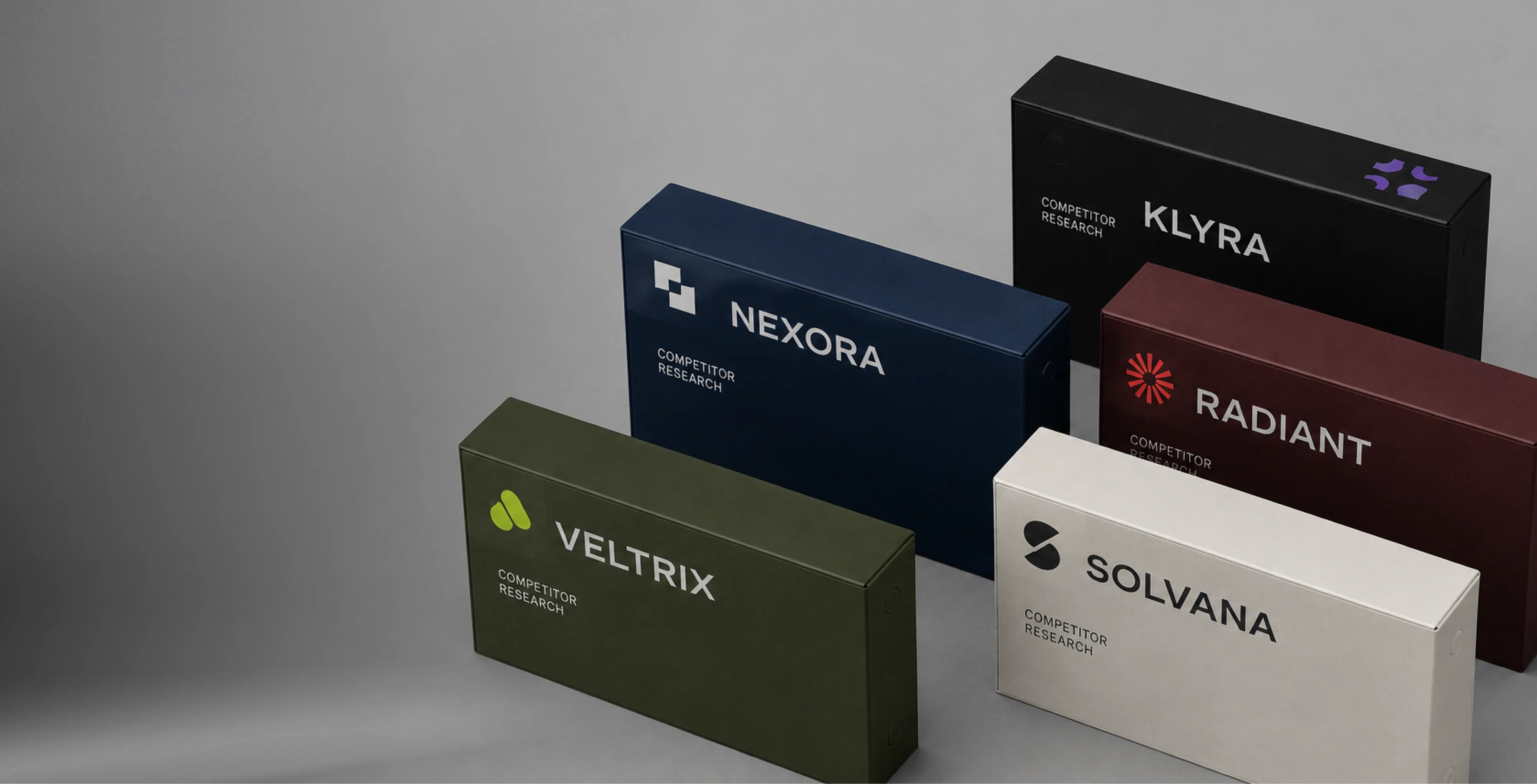
Competitor analysis services map the field before you position in it. Brand Vision documents each rival's positioning, messaging, identity, and pricing signals. We mark where claims overlap and where credible space sits open. For a new brand, that open space is where the strategy starts. For an existing one, the comparison becomes the competitive section of a brand audit. The deliverable is a landscape specific enough to brief strategy and design directly.
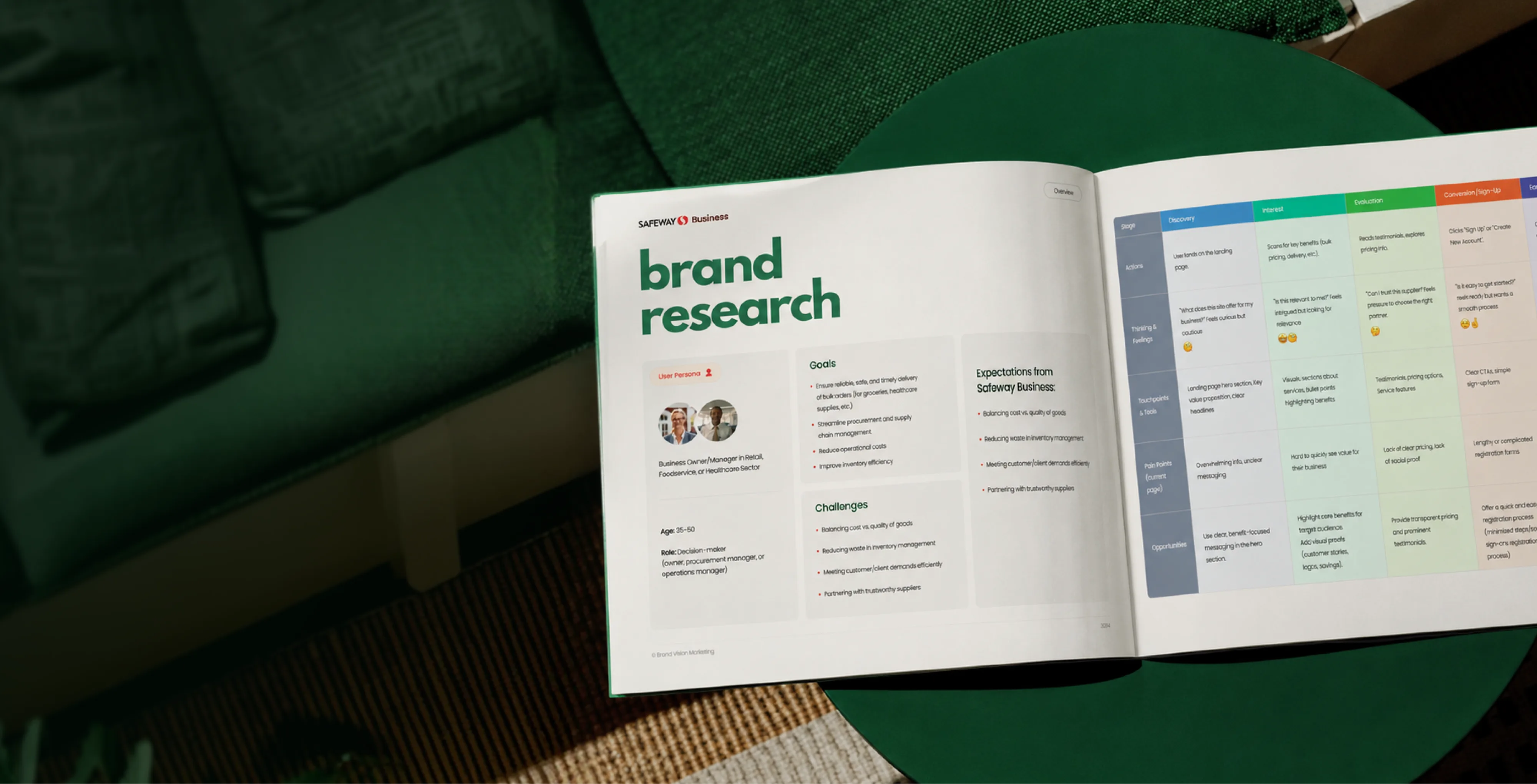
Every brand decision assumes an audience. Brand Vision replaces the assumption with customer research. We identify the segments, size them, and profile how each one decides, the priorities, the objections, the alternatives considered. Interviews with real buyers supply the language and the doubts that surveys flatten. A new brand strategy gets built on these findings. An established brand gets checked against them during a brand audit, because audiences change faster than positioning does.

Industry and trend research shows where a category is heading before you commit a brand to it. Brand Vision tracks how buyer expectations are shifting. Which conventions are hardening. Which are losing force. What new entrants are teaching customers to expect. The findings tell a brand strategy which trends to build on and which to ignore. Within a brand audit, the same lens shows whether an existing brand has fallen behind its category or moved ahead of it.
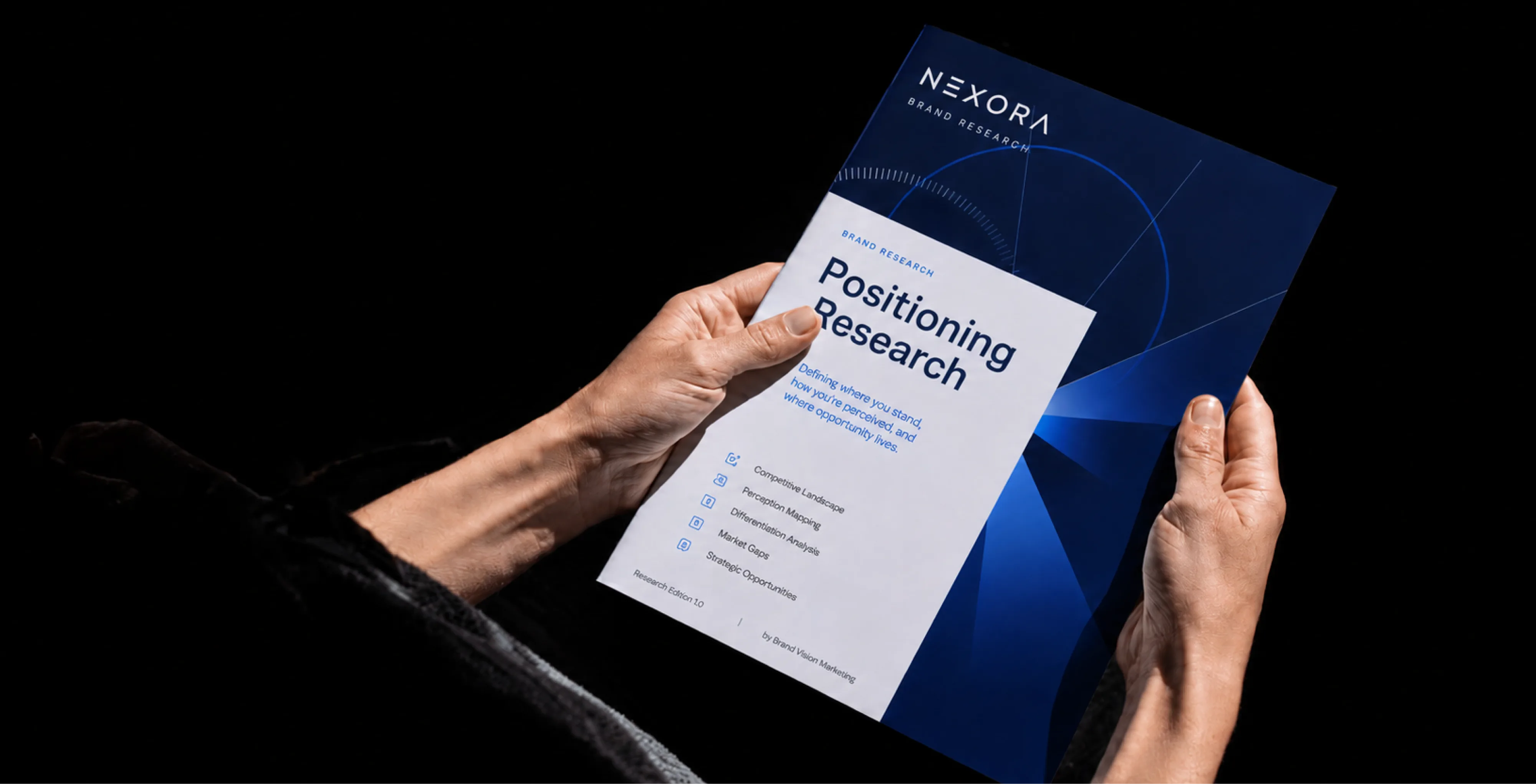
Brand positioning research maps the ground available before a position is chosen. Brand Vision documents what every player in the category claims. Where the messaging crowds together. Which territories sit open and whether they are open for a reason. We test candidate positions against what the audience values and what the product can support. The strategy then starts from a defensible choice, not a preference. In a brand audit, the same map scores the position you already hold.

Brand perception research establishes what the market currently believes. For a new brand, that means the category's associations, which ones help, which hurt, and which competitor owns each, so the strategy works with real starting beliefs. For an existing brand, a brand perception study measures the gap between the position you intend and the one customers describe. Brand Vision gathers the data from surveys, interviews, reviews, and social listening. Commissioned alone, ahead of a strategy, or inside a brand audit.
From the question to evidence a decision can act on.
We pin down exactly what the brand decision needs to know before choosing any method.
We pick the right method for each question, industry data, surveys, interviews, reviews, and social listening.
Findings are scored and ranked by business impact, with strengths named as clearly as gaps.
You receive the evidence reported plainly, ready to feed a strategy or open an audit.
Brand research services and brand audit projects, with the findings and outcomes.
Brand Vision runs its brand research services, from audience analysis to a full brand audit, against the standards of the client's own industry, with methods that hold across categories.












Product depth shouldn’t slow the story down. We partner with SaaS, platform, and enterprise software teams to translate technical capability into focused narratives. Clear paths to demo, trial, or contact serve both buyers and technical evaluators. Systems are built for product-led growth with composable components, editor guardrails, and instrumented analytics that tie directly to pipeline.
Complex services sell on clarity, not volume. We help consulting, financial, and advisory firms structure their digital presence around buyer tasks: understanding capabilities, comparing options, and starting a brief. Every touchpoint earns trust through specificity and proof. Content is organized by audience need, so the people making the hiring decision find answers quickly and move to contact without friction.
Patients and practitioners make high-stakes decisions under pressure. We design trust-first experiences for healthcare and wellness brands, keeping clinical accuracy intact while making it simple for people to find the right provider, service, or next step. Accessibility, privacy-compliant forms, and plain-language content are standard. Local visibility for practices and clinics is built into the foundation, not bolted on later.
Prospective clients searching for legal help are often under pressure and comparing firms quickly. We help law firms present practice areas with credibility, surface the right contact paths, and build a digital presence that earns trust before the first conversation. Clear structure, plain language, attorney profiles, and consultation flows make it easy for people to take the next step with confidence. Ethical advertising compliance is built in from the start.
Buyers, investors, and project owners move on trust and timing. We work with brokerages, developers, general contractors, and property management firms to present listings, projects, and capabilities with clarity. Content is organized around what prospects actually need: proof of work, service scope, location context, and a direct path to inquire. Pre-construction launches and trade portfolios get the same strategic rigor as resale platforms.
Conversion lives in the details. We work with consumer and ecommerce brands to build fast, clear shopping experiences where product pages explain value quickly, checkout flows reduce friction, and the entire system scales with the catalog. Promotional templates, collection architecture, and performance monitoring keep the storefront sharp as demand and inventory shift with seasons. The result is a store your team can run day to day without developer dependency.
Early-stage companies need focus over flash. We help startups define positioning, build a credible identity, and launch a conversion-ready presence that clearly communicates what the product does, who it’s for, and how to get started. Everything is built to scale: component systems, content structures, and analytics foundations grow with the roadmap instead of needing a rebuild at Series A. The pitch and the website tell the same story.
Students, parents, and administrators all need different answers from the same site. We help schools, universities, and training organizations structure digital experiences by task: apply, visit, inquire, enroll. Accessible design and plain-language content serve diverse audiences without alienating any of them. A manageable CMS means internal teams keep program pages, event listings, and admissions information current without outside help or bottlenecks.
Nonprofits compete for attention, funding, and volunteers simultaneously. We build accessible digital experiences that make programs clear, donation paths intuitive, and calls to action specific enough to drive real participation and support. Content governance is designed for lean teams, so pages, campaigns, and impact reports stay current without bottlenecks. The organizations doing the most important work deserve a digital presence that matches their mission.
From restaurants to packaged goods, this industry sells on quality and convenience. We help food and beverage brands connect story with logistics: clear menus, product lines, ordering options, and wholesale paths that make it obvious how to buy and reorder. Identity and digital experience work in tandem so visitors see quality and know exactly what to do next, whether they’re a consumer walking in or a distributor placing a first order.
Audiences decide in seconds. We work with labels, venues, talent agencies, and event companies to build media-rich, performance-optimized experiences where the work is front and center. Booking, inquiry, and ticket paths stay visible and fast across devices. Campaign templates and component systems let teams launch content for new shows, releases, and events without starting from scratch each time. The creative comes first; the infrastructure stays invisible.
Guests research and book across multiple touchpoints. We help hotels, resorts, tourism brands, and event venues present their experience with clarity, connecting visual storytelling with practical booking flows, local discovery, and seasonal content that stays current. The systems we build make it straightforward for teams to update rates, packages, and promotions without depending on a developer for every change. The experience starts online, and it should feel as considered as the stay itself.











Original research and expert perspective on design, branding, and the strategy behind both.
Still have questions? Contact us to discuss.
A brand research agency answers the questions a brand decision rests on before the decision gets made, and a brand audit asks them again once the brand is out in the market. Both jobs come down to the same thing, which is replacing what a leadership team assumes about its buyers, its category, and its own reputation with something that has been checked.
The plain version. Somebody has to establish who actually buys, what they weigh you against, what they already believe about you, and where the category is heading. Most companies answer those four from memory, from three loud customers, or from a study nobody has opened since the last leadership change.
Getting them wrong is rarely visible as a failure. It shows up as a homepage describing a buyer who left the category two years ago, a sales deck answering an objection prospects stopped raising, and a proposition aimed at the segment that is easiest to talk to instead of the one that pays.
Why clients bring the work to us.
We publish research, so we are not learning the method on your budget. More than 25 original brand studies published under our own name, using the same instruments we run for clients.
Findings arrive ranked by business impact. Forty observations in a document is note-taking. Every finding gets scored and ordered, and the strengths get named as precisely as the problems, because knowing what to protect is half of what you are paying for.
The research has somewhere to go. It feeds the positioning and the identity system that follows, or it opens a repair plan, and the people who ran the study stay in the room while the findings turn into a position, a design system, and copy.
We say when the question is already answered. Where published industry data settles it, we tell you and scope smaller. That happens more often than the category likes to admit.
Behind that sits over 10 years of brand research and 250+ verified five-star reviews from the engagements it fed. You can read the work it produced and see who runs it before committing to anything.
Seven, and they split cleanly into research done before a brand exists and an audit of one already trading. Most engagements use three or four of them together.
Brand audits. A structured examination of what your brand claims, how consistently it shows up, how it stacks against direct rivals, and how customers describe you unprompted. Scored, gap by gap, ranked.
Market research. Sizing and structure. Who is in the market, how it segments, what it pays, what is growing and what is quietly flat. Sizing is built from published industry data and your own numbers first, since a market you can only estimate from a survey is an estimate with a survey attached.
Competitor research. Every rival's positioning, message hierarchy, identity, proof, and pricing signals documented side by side, so overlap and open ground are visible instead of argued about. Six to ten direct competitors is the usual set, and a landscape stretched to thirty stops being read.
Target audience research. Segments identified, sized, and profiled on how they actually decide, including the objections and the alternatives they consider before you.
Industry and trend research. Where buyer expectations are moving, which category conventions are hardening into requirements, and which are losing their hold.
Brand positioning research. The available ground mapped before a position is chosen, with candidate positions tested against what buyers value and what the business can support.
Brand perception research. What the market currently believes, measured. For an established brand that means the distance between the position you intend and the one customers repeat back. For a brand about to launch it means a baseline recorded before anything ships, so the change can be measured later instead of asserted.
Any of these can be commissioned on its own. More often they combine, either into the evidence base under a larger engagement or into a diagnostic that tells you whether the problem in front of you needs a repositioning, a redesign, or nothing at all. If you are unsure which you need, that is a conversation for a short consultation and not a proposal.
A brand audit is a scored examination of a brand already in market, built on four questions and delivered as a ranked list of things to fix and things to defend. It is a diagnostic, so it produces evidence and priorities and not new creative.
There are four questions, in the order we run them.
Scoring turns those into something a leadership team can act on. Each area gets a score with the evidence attached, findings are ranked by business impact so the top three are obvious, and effort is noted next to each so the cheap wins are separable from the twelve-month work. Strengths are documented with equal care, because the fastest way to damage a brand is to fix the wrong part of it. Where the audit concludes the identity itself is the constraint, the next step is identity work or a full rebrand, and where it concludes the position is the constraint, the finding goes into strategy instead.
Market research asks whether people will buy a thing and at what price. Brand research asks what they believe, who they credit for it, and why they pick one supplier over an identical one. The methods overlap almost entirely. The question does not, and the question is what determines whether the findings are usable.
An example makes the split obvious. Market research can tell you the category is growing 12 percent, that mid-market buyers hold the budget, and that the average deal has doubled in three years. All true, all useful, and none of it tells you what to say. Brand research tells you those buyers assume anybody your size cannot handle their volume, that they check two rivals by default and you are not one of them, and that the word your customers use for what you do is not the word on your homepage. That is the kind of finding a position, a headline, and a pricing conversation can be built on.
This is also why we run both under one roof. A sizing study with no perception work produces a market you understand and a brand nobody can distinguish inside it. Perception work with no sizing produces sharp language aimed at a segment too small to fund the business.
The deliverable differs too. Market research usually lands as numbers with a commentary. Brand research has to land as decisions somebody can argue with, which means the report says what the finding implies and what we would do about it, and stops short of pretending the data chose for you. It also names what the evidence cannot settle, which is the section most research documents quietly leave out.
Both feed the same next step. Findings become the input to positioning and messaging work, and where the market picture is what a business is missing, it usually needs a view of its own sector before anything else. Where you sit in a category with only a few hundred real buyers, B2B research works differently again, which is covered further down.
A focused brand audit runs three to four weeks. A research program with fresh interviews and a survey behind it runs six to ten. The variable is almost never analysis speed. It is how long it takes to get the right people to talk to you.
Define. Two to four days. We write down the decision the research has to serve and the questions that decision depends on, then agree what evidence would count as an answer. Skipping this is how studies end up interesting and unusable.
Gather. One week if the answers sit in existing data, three to five if primary research is in scope. Recruiting eight senior buyers in a narrow industry takes longer than fielding four hundred consumer responses, and it is the single most common reason a timeline slips.
Analyze. One week. Coding the qualitative material, running the cross-tabs, scoring each area, and ranking findings by business impact.
Report. Three to five days. A written document, the evidence behind each finding, and a working session where the team argues with it while we are still in the room.
What moves the price. How much primary research is involved, since recruited interviews and incentives are real cost and panel completes are billed per response. The number of segments, because each one needs its own sample to say anything about. How many markets and languages. Whether an audit covers one brand or a portfolio. And whether you need a direction or a fully documented evidence base your team can work from for two years.
Where budget is tight, there is an honest smaller version. A competitor and perception scan, two weeks, enough to tell you whether the problem is the position, the expression of it, or the distribution, and enough to stop a redesign that would have solved nothing. That kind of scoping question is what a consultation is for, and if what you actually need is a full brand engagement we will say so instead of selling research twice.
You know your customers. Almost nobody knows their non-customers, and that is where the expensive surprises live. Four beliefs fail a check often enough that we look at them first.
Everyone you have asked already said yes to you. Your customer list is a group of people who chose you, which makes it a poor sample for understanding why anybody does not. The buyers who compared you and went elsewhere hold the information you are missing, and they will usually tell you if somebody neutral asks.
A few strong opinions get mistaken for a pattern. Two vocal accounts and one board member with a theory can steer a whole roadmap. Research does not make those voices wrong, it establishes whether they represent forty percent of the market or four. Two loud accounts inside a base of four hundred is half a percent of your customers steering a roadmap the other 99.5 percent has to live with.
Founders and sales leads get a filtered version. People soften criticism in front of the person who owns the company, and they soften it more when a renewal is coming. The same person will describe a real frustration in detail to an interviewer with no stake in the answer. This is not a comment on anybody's relationships, it is how conversations work.
The last real look was years ago. Buying committees grow, average age of the buyer shifts, new entrants retrain expectations, and the way people search changes entirely. A study from before AI assistants started summarizing vendors for buyers describes a different decision process from the one you are selling into now, which is worth knowing before you plan for AI search visibility.
When you can reasonably skip it. You talk to lost deals routinely and write down what they say. Your category is small enough that you know every buyer by name and speak to them. Or the decision in front of you is genuinely tactical and reversible. In those cases we would rather point you at the work itself and keep the research budget in your pocket.
Enough to reach the point where new conversations stop producing new information, which in practice is usually ten to twelve interviews per segment. After that, the themes repeat and further conversations mostly buy you confidence rather than insight.
The sequence runs like this. First we establish the segments, and we build them on how people decide instead of what they look like, because two companies of identical size in the same industry can buy in completely different ways. Then each segment gets sized against industry data, since a segment nobody can quantify is a hypothesis. Then we write a screener, which is the short set of qualifying questions that keeps the wrong people out of a study that is meant to be about one specific buyer.
Recruitment is where the honesty matters. Senior buyers need a reason to give you forty minutes, so incentives, timing, and a short interview are part of the design. And who you include decides what you learn. A study of current customers tells you why people stay. Add lost opportunities and you learn what beats you. Add churned accounts and you learn what breaks. In committee purchases, add the people who influence and block rather than sign, because the person who kills the deal is rarely the person on the proposal.
What interviews give you that a survey cannot. The actual words buyers use for the problem, which is what should be on the site. The order in which they consider things. The doubt they never write in a form field. And the alternative they nearly went with, which is frequently doing nothing.
Where scale is needed we field a survey behind the interviews, using the interviews to write questions that make sense to the audience. Four hundred responses per segment brings the margin of error near five points, which is enough to act on. One hundred does not, and we will say so before you spend on it.
If the question is about how a specific interface gets used rather than how a brand gets chosen, that is UX research and a different method, and the two often run together ahead of a website project.
Competitor analysis services document the field precisely enough that open ground becomes a fact instead of an opinion. The mistake is treating an empty territory as an opportunity without asking why it emptied.
What gets documented for each rival. The positioning claim in their own words. The message hierarchy underneath it, meaning what they lead with and what they bury. Proof, including named customers, numbers, credentials, and published work. Identity and how far it strays from category convention. Pricing signals, since public pricing, packaging names, and the language around discounts reveal strategy. Channel presence and where they concentrate spend. Then, most usefully, the words they all use.
That last one is where clustering shows up. When six competitors claim partnership, innovation, and being trusted, none of those is available in any meaningful sense, and every one of them is expensive to compete on. The gaps that remain get sorted into three kinds.
Open and worth taking. Nobody claims it, buyers care about it, and you can support it with something real. This is the one you want and it is rarer than it sounds. The test is to write the claim as a single sentence and ask whether any rival could publish it tomorrow without lying. If they could, the ground is not actually open.
Open because nobody can support it. The claim is available because backing it requires capability none of you have. Taking it means being caught, so it stays empty.
Open because nobody wants it. The territory sits free because buyers are indifferent to it. Plenty of distinctive brands are distinctive in a way the market does not reward.
Candidate positions get tested against those three before anything is chosen, which is the part positioning work depends on. The same landscape doubles as the competitive section of an audit, and it is what stops a new name or a new identity from landing three degrees away from a rival nobody remembered to check. Examples of where that mapping changed the outcome sit in our project work.
Brand perception research triangulates it, because no single instrument gives you an honest number on its own. What you are measuring is the distance between the brand you intend and the brand that exists in other people's heads, and that gap is where most marketing budget quietly goes.
We use five sources and read them against each other.
A survey, structured so unaided recall comes first. Asking which suppliers come to mind in a category before naming any is the only way to learn whether you exist without a prompt. Aided awareness follows, then attribute association, where respondents assign qualities to the players they know. Association is the number that matters, since being known for nothing in particular and being unknown behave the same way commercially.
Interviews, for the reasoning underneath the ratings. A score of four out of seven on trustworthy tells you very little. Ten minutes on why produces something fixable.
Review and mention mining. Reviews, forums, and comment threads carry the criticism nobody delivers to your face, and the recurring phrases in them are more reliable than anything volunteered in a survey.
Social listening, for volume and sentiment over time and for how you are described relative to competitors in the same conversations.
What AI assistants say about you. Buyers increasingly ask a model to shortlist suppliers, and the answer it gives is assembled from what third-party sources say, not from your homepage. Asking the same questions your buyers ask and recording what comes back is now part of a perception baseline, and where the answer is wrong or absent that becomes a visibility problem in AI answers with a specific fix.
Two cautions we give every client. A single satisfaction score is a poor brand measure, because it surveys people who already bought and tells you nothing about the market that did not. And every self-reported answer carries some tendency to say the agreeable thing, which is why behaviour and unprompted language get weighted above stated preference. The baseline gets recorded so the same questions can be asked again once the repositioning and the marketing carrying it have been in market long enough to move anything.
By separating the shifts that change what a buyer expects from the ones that only change what designers are doing this year. One of those has consequences for a brand. The other has consequences for a portfolio.
The test we apply is whether a shift has altered the buyer's standard of normal. When enough companies in a category do something, it stops being a differentiator and becomes an entry requirement, and failing it costs you consideration without ever showing up as a complaint. Transparent pricing did that in software. Same-day answers did it in service categories. Visible sustainability documentation is doing it now in several consumer sectors. None of those distinguishes anybody anymore, and all of them will lose you deals if they are missing.
Four things we track. What new entrants are teaching customers to expect, since a well-funded newcomer trains a whole market on a standard the incumbents then have to meet. Where category conventions are hardening into requirements. Which conventions are losing force, because those are where distinctiveness gets cheap. And how the discovery path itself is moving, which right now means buyers arriving with a shortlist assembled somewhere you were not present.
What we do with it depends on which side of the line the finding falls. Requirements get met without ceremony, since there is no credit for meeting a baseline. Loosening conventions become candidates for the position, because that is where you can look different without looking wrong. And genuine shifts in the buying path change where budget goes more than they change the brand, which is usually an argument about content and organic visibility more than an argument about design.
Inside an audit the same lens does one extra job. It shows whether a brand has drifted behind its category, which reads as tired, or ahead of it, which reads as unfamiliar and is the more expensive of the two mistakes. We run that comparison against the standards of your own sector, since what looks conservative in one industry looks reckless in another, and the answer often lands in design and web work rather than in strategy.
Four different audits, four different objects of study, and none of them substitutes for another. Teams often buy one and expect the findings of a different one, so here is the split.
A brand audit examines meaning. What you claim, whether you say it consistently, how it compares, and what customers repeat back. It answers whether the brand is understood and whether it is distinguishable. It will not tell you why a page loads slowly.
An SEO audit examines findability. Crawlability, indexation, site structure, content coverage against demand, and the technical conditions for ranking. It answers whether the right people can find you at all, which is a separate failure from being misunderstood once they arrive.
A UX audit examines behaviour on the page. Where people hesitate, abandon, and misread, judged against the task they came to complete. It answers whether the experience works, and it is silent on whether the promise it is delivering is the right promise.
A website audit sits across the middle, covering performance, accessibility, conversion structure, and content quality, and it is usually the first step in a redesign scoping exercise.
The practical difference is what each one can conclude. A brand audit can conclude the strategy is wrong. The others can only conclude the execution is. That is why a company with declining enquiries and healthy rankings almost always has a brand problem, and a company with a sharp position and no traffic has a search problem, and treating one with the other is the most common way both budgets get wasted.
Read together, they answer the whole question. That is how we scope diagnostic work, and where an engagement needs more than one, the findings are reconciled into a single ranked list instead of three documents that disagree. Sequencing them properly is the most common reason a client asks us which one to buy first, and the full service picture is worth a look if you are not sure which door you are meant to come through.
Research that only confirms what the room already thought was expensive note-taking, so the design has to give the uncomfortable answer a route in. Reliability comes from a handful of unglamorous practices, and every one of them is checkable.
Questions get written so they cannot lead. Asking whether customers value craftsmanship produces agreement almost every time. Asking what they compared you against and why they chose produces something true. Anything phrased to invite the answer we hope for gets rewritten before fielding.
Samples get sized before they get collected, and the limit gets stated in the report. Where a category has two hundred total buyers, no honest survey will produce statistical significance, so the study is qualitative by design and the write-up says that plainly instead of dressing eleven conversations up as a percentage.
Interviews are run by somebody with no stake in the answer, which is the main reason to bring this in from outside rather than have the sales team do it between calls.
Who was not included gets recorded. The people who declined to participate are frequently the most dissatisfied, and a report that ignores them overstates how well things are going.
And findings that contradict each other stay in. Two segments wanting opposite things is a real result with real implications, usually about which one you are willing to lose.
Then there is the part clients ask about privately. What happens when the research says the thing leadership does not want to hear. We present it with the evidence attached, we separate what the data supports from what we would recommend, and we do not soften a finding because it is inconvenient. What we will not do is claim certainty the sample cannot carry, since a finding oversold once poisons the next three studies.
Afterward it moves. Findings become the evidence base for positioning and messaging, the trigger for a rebranding program where the audit concludes the current one is the constraint, or the baseline for a re-measure in twelve to eighteen months so the marketing work that follows can be judged against something. If you want to talk through which of those your situation actually calls for, start there.

Our goal is to nurture your vision and provide innovative, custom solutions for all your marketing needs.


%2520(1).png)
.png)