If you are planning a website, the difference between web design and web development matters because the two disciplines solve different parts of the same problem. Design shapes how the site communicates, looks, and guides people through an experience. Development turns that experience into a working digital system, handling code, data, integrations, performance, and technical behavior.
The roles overlap more than simple job titles suggest, especially on smaller teams, but the distinction is still useful when you are hiring, planning a project, or choosing a career path. The strongest websites are usually built through collaboration rather than by treating design and development as separate handoffs.
Web Design vs. Web Development: The Core Difference
Imagine you are launching an online store. The designer decides how product information is organized, how navigation works, how the visual system reflects the brand, and how customers move toward checkout. The developer makes the storefront function across devices, connects products and inventory to the right systems, implements the cart and checkout logic, and ensures the experience behaves reliably once real customers arrive.
A useful house-building analogy still applies: the designer is close to the architect, defining the experience and how people move through the space, while the developer is closer to the builder and engineer, translating that plan into a stable system. In practice, good teams involve both disciplines early so technical constraints and user needs influence decisions before they become expensive to change.
What Is Web Design?
Web design covers the visual and user-facing structure of a website: layout, hierarchy, navigation, typography, color, imagery, responsive behavior, and the way key actions are presented. For a deeper distinction between interface and experience work, our UI vs. UX guide explains how the two relate. Designers also make decisions about typography and often work alongside specialists in UI/UX design.
- User experience and interface design. Designers map how visitors move through the site, decide what information appears first, and create wireframes or prototypes before final screens are approved. Strong decisions are often grounded in UX research rather than taste alone.
- Design tools and systems. Figma and Sketch are common tools for layouts, prototypes, reusable components, and design systems. The software matters less than having a clear system developers can implement consistently.
- Collaboration with code. Some designers know HTML and CSS, and some work directly in visual development platforms. Others focus entirely on design. The role is defined by responsibility for the experience, not by a rule that designers never touch code.
Good web design balances clarity with brand expression. Designers need to follow current web design trends selectively rather than treating every trend as a requirement, and the website should translate a coherent visual identity into a usable digital experience.
What Is Web Development?
Once the experience is defined, a web developer implements the technical system that makes it work. Development can cover everything from the browser interface to servers, databases, APIs, authentication, content-management systems, and third-party integrations.
- Front-end development. Front-end work covers everything you see on-screen, using HTML, CSS, JavaScript, and frameworks or platform tools to implement layouts, interactions, accessibility, and responsive behavior.
- Back-end development. Back-end work powers the behind-the-scenes logic, including server-side applications, databases, permissions, data processing, and connections to other systems.
- Full-stack development. Some developers work across both front-end and back-end. On larger products, those responsibilities may be divided among several specialists rather than one person.
- Testing and technical quality. Developers use version control, development environments, automated or manual testing, and monitoring to improve reliability, accessibility, security, performance, and browser compatibility.
Development is not simply the phase that begins after design is finished. Developers can identify technical risks during planning, suggest more efficient interaction patterns, and help decide which platform or architecture fits the project before detailed screens are finalized.
Key Differences Between Web Design and Web Development
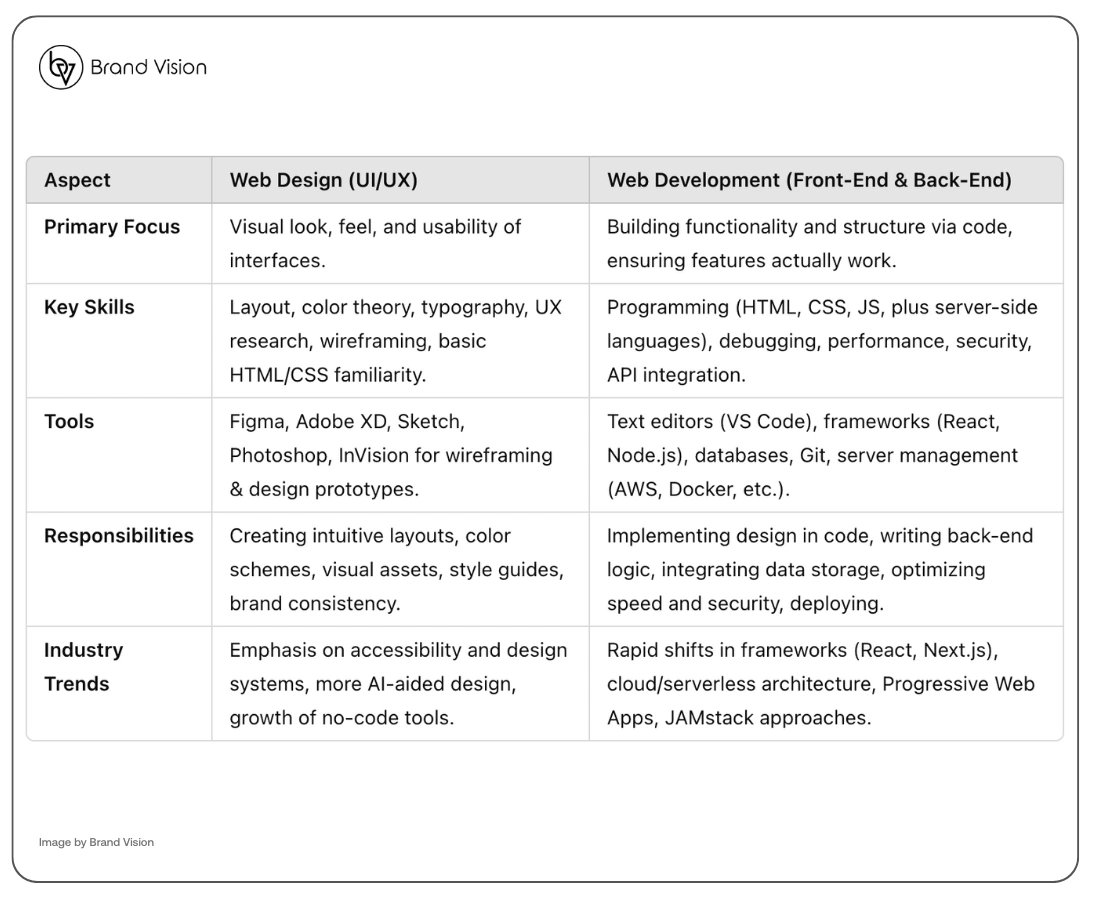
- Primary focus
- Design focuses on communication, visual hierarchy, usability, interaction, and the user journey.
- Development focuses on technical implementation, data, functionality, reliability, and maintainability.
- Typical tools
- Designers commonly use Figma, Sketch, prototyping tools, asset libraries, and design systems.
- Developers commonly use code editors or IDEs, Git, browser developer tools, frameworks, package managers, testing tools, and deployment systems.
- Core skills
- Designers rely on visual judgment, information hierarchy, interaction thinking, accessibility awareness, and empathy for user behavior.
- Developers rely on programming, systems thinking, debugging, performance work, and translating requirements into maintainable implementations.
- Workflow
- Design often leads early exploration, but development should influence planning before every screen is finalized.
- Development implements the approved system, while feedback from implementation can trigger design revisions.
- Career direction
- Designers may move toward product design, UX leadership, design systems, or creative direction.
- Web Developers may specialize in front-end, back-end, platform engineering, accessibility, performance, or full-stack work.
How Web Designers and Developers Collaborate
A productive collaboration starts before the handoff. Designers can test flows and responsive behavior while developers flag performance, platform, and implementation constraints. The team can then iterate on a shared solution instead of discovering conflicts after the design is considered finished. Principles such as mobile-first and responsive design are a good example: layout choices and implementation choices need to work together.
- Designers refine layouts, states, components, content hierarchy, and interactions as technical feedback emerges. For teams that want one accountable partner, a full-service agency can coordinate strategy, design, and development in one process.
- Developers translate components into production, identify edge cases, and advise when an animation, integration, or page structure introduces unnecessary complexity or performance cost.
This coordination is particularly important for technology and SaaS websites, where marketing pages, product education, demos, onboarding, integrations, and application-like interactions may need to feel like one coherent experience.
Career Paths in Web Design and Web Development
Web Design Career Path
Web designers often come from graphic design, digital media, UX, product design, or related backgrounds. Early roles may focus on production and page layouts, while senior roles take on research, interaction systems, creative direction, accessibility, and design governance. Some designers learn enough front-end development to prototype directly in code or visual development tools.
Web Development Career Path
Developers often enter through computer science programs, technical colleges, bootcamps, self-directed study, or adjacent engineering roles. They may specialize in front-end, back-end, CMS implementation, platform engineering, or full-stack work. Senior developers increasingly take responsibility for architecture, technical standards, code review, security, performance, and mentoring.
In many teams, both disciplines work in the same product or delivery cycle, reviewing work together rather than operating as isolated departments. That makes communication and shared documentation as important as any individual design or coding tool.
Which One Do You Need?
- If your website works but feels dated, confusing, or disconnected from the brand, start with design or a broader website redesign.
- If the site needs new features, integrations, performance fixes, or technical repairs, development is the primary need.
- If you are building from scratch, plan for both disciplines. When evaluating providers, our guide to choosing a web designer can help clarify what to look for beyond visual style.
For simpler sites, no-code tools may reduce the amount of custom development required, while more complex projects still benefit from technical planning. If you are considering automated options, compare the trade-offs of AI website builders. If the larger question is which system to build on, review the major website platforms before committing to a stack.
Location can matter when close collaboration is valuable. For organizations that prefer a local partner, a Chicago web design and development agency can coordinate the design and technical work under one project while still bringing in specialist expertise where needed.
Web Design and Development Work Best Together
Web design and web development are different disciplines, but they are not competing approaches. Design defines how people understand and use the experience. Development makes that experience functional, reliable, responsive, and maintainable. The best results come from bringing both perspectives into planning early, then keeping the feedback loop active through launch.
If your project needs both sides coordinated, contact Brand Vision to discuss the website, the technical requirements, and the team structure that fits the scope.